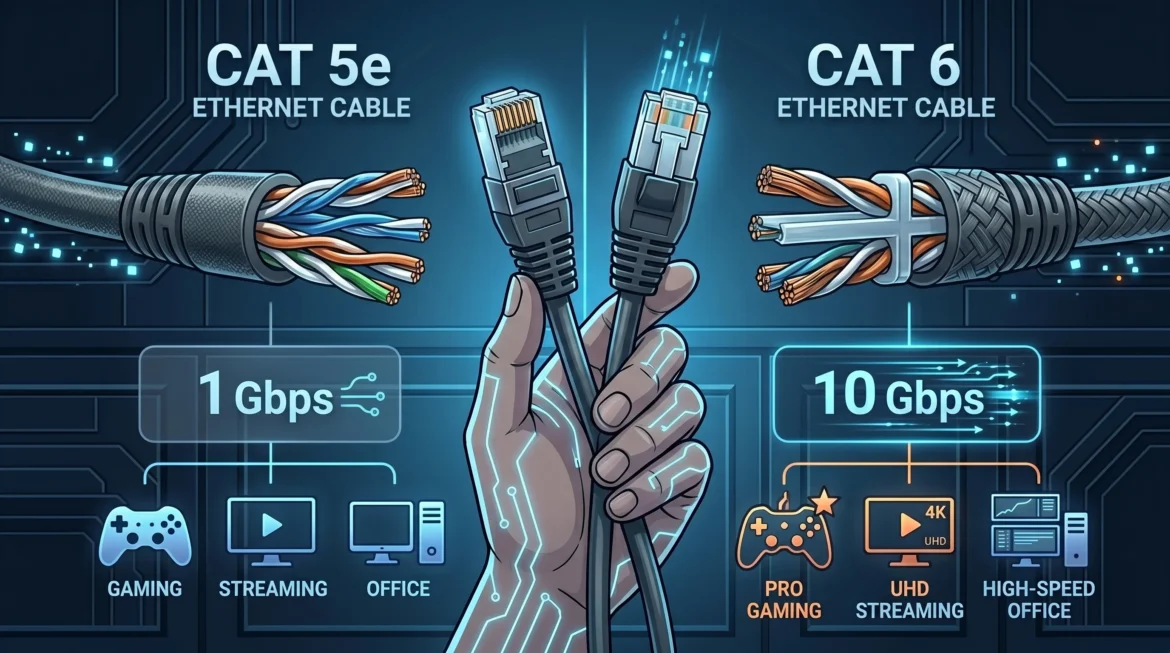
If you are upgrading your home network or setting up a new internet connection, you have probably come across the debate about Cat 6 vs Cat 5e Ethernet cable options. While both cables look similar, they offer different levels of speed, bandwidth, and future readiness.
The good news is that choosing the right Ethernet cable does not have to be complicated. Most people simply want to know whether Cat5e is enough for their needs or if spending more on Cat6 is worth it.
In this guide, we will compare Cat5e and Cat6 in simple terms. By the end, you will know exactly which Ethernet cable suits your internet speed, devices, gaming habits, and budget.
Quick Answer: Is Cat6 Better Than Cat5e?
Yes, Cat6 is technically better because it supports higher bandwidth and can handle 10 Gigabit Ethernet over shorter distances.
However, Cat5e remains an excellent choice for most households. If your internet plan is below 1 Gbps and you mainly use the internet for gaming, streaming, remote work, and everyday browsing, Cat5e is often more than enough.
Choose Cat5e if:
- You want an affordable solution.
- You use Gigabit internet.
- You have standard home networking needs.
Choose Cat6 if:
- You want future-proof networking.
- You plan to upgrade to multi-gig internet.
- You use NAS systems or home servers.
- You regularly transfer large files.
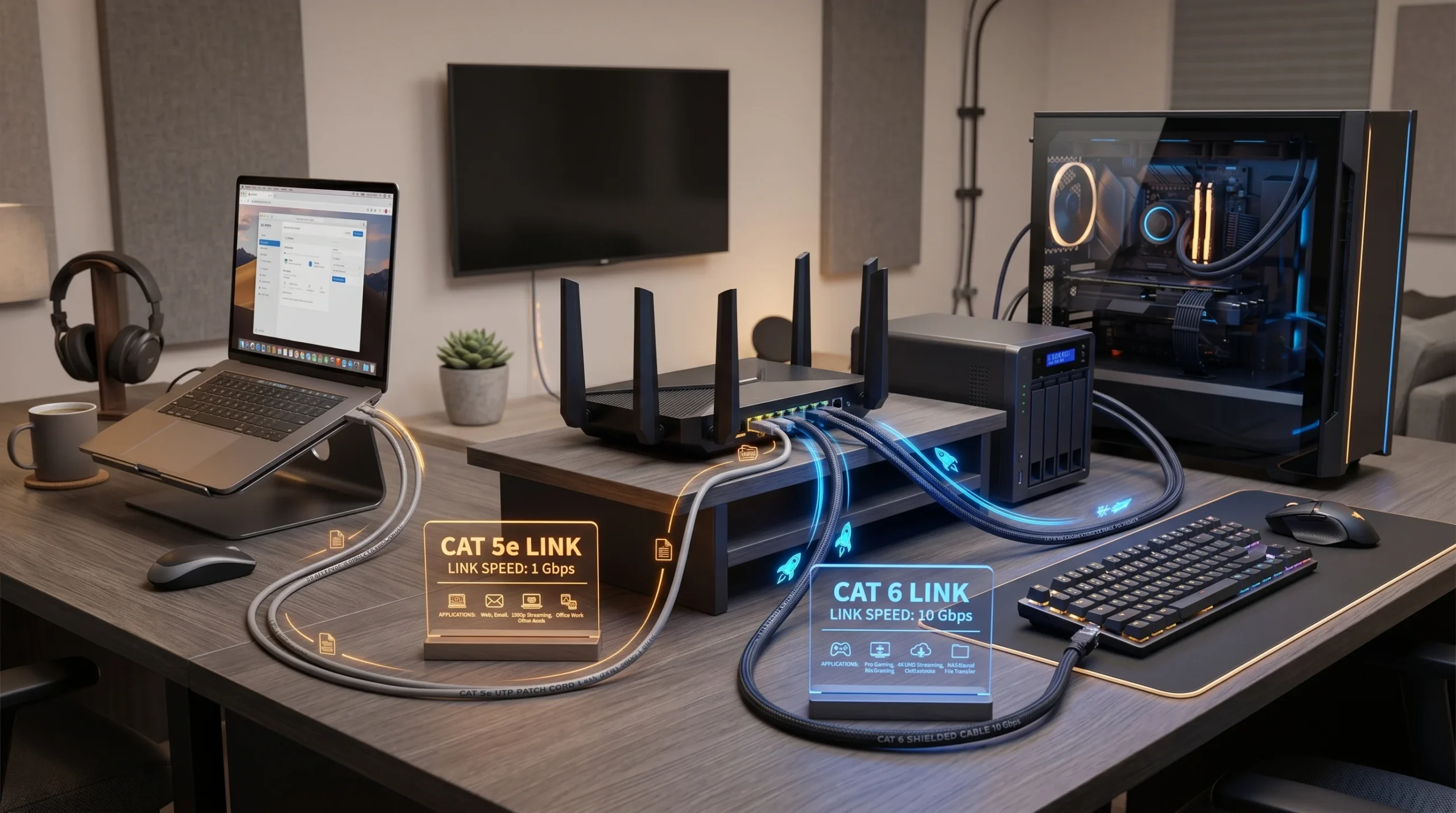
Cat6 vs Cat5e at a Glance
| Feature | Cat5e | Cat6 |
|---|---|---|
| Maximum Speed | 1 Gbps | 10 Gbps |
| Bandwidth | 100 MHz | 250 MHz |
| Maximum Distance | 100 meters | 55 meters at 10 Gbps |
| Price | Lower | Higher |
| Crosstalk Protection | Good | Better |
| Flexibility | More flexible | Slightly thicker |
| Gaming | Excellent | Excellent |
| Streaming | Excellent | Excellent |
| Future Proofing | Moderate | Strong |
| Best For | Home users | Advanced users |
What Is Cat5e Ethernet Cable?
Cat5e stands for Category 5 Enhanced. It is one of the most widely used Ethernet cable standards for residential networking.
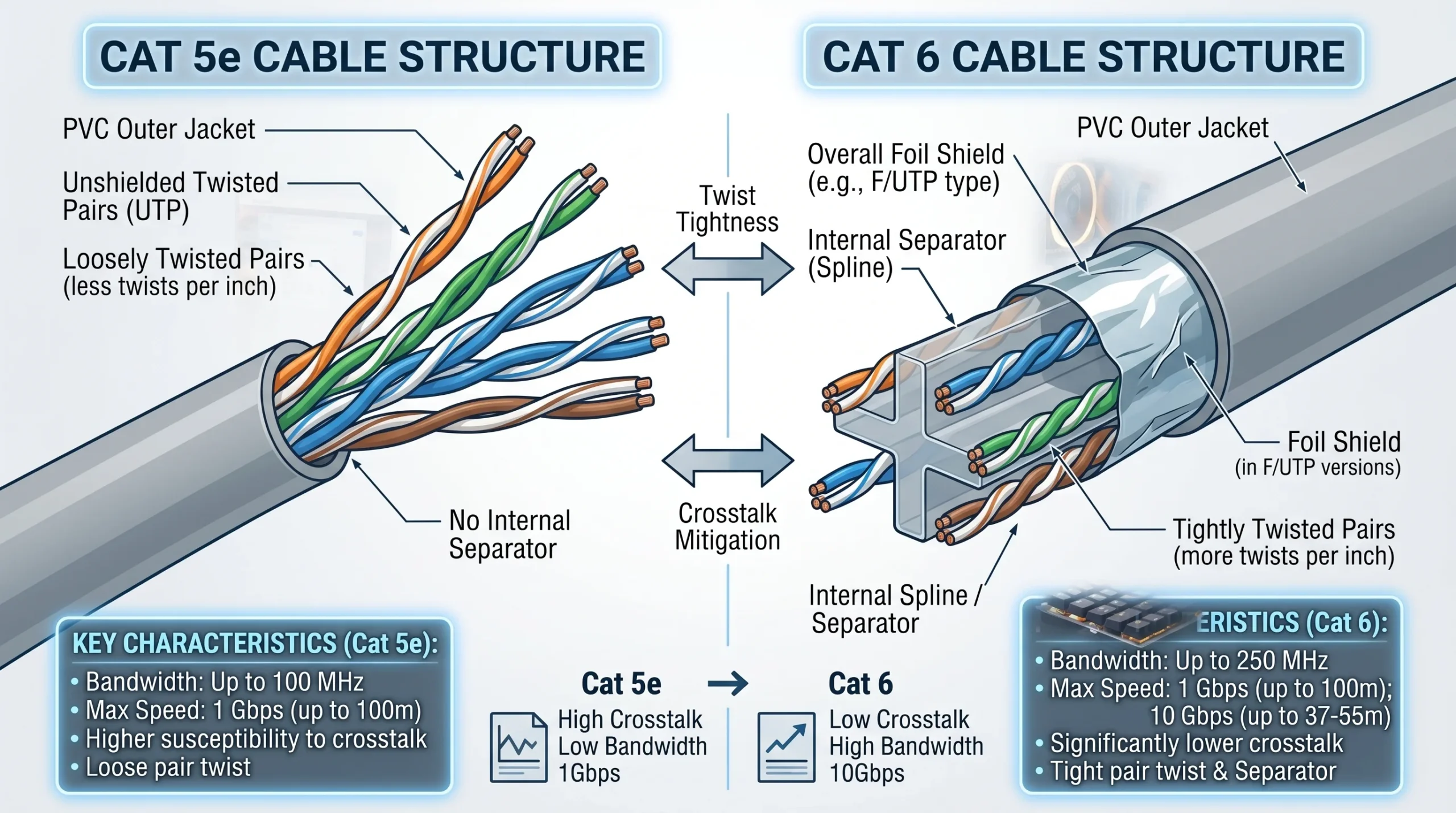
A Cat5e Ethernet cable supports Gigabit Ethernet speeds up to 1 Gbps across distances of up to 100 meters. It uses twisted-pair cable construction to reduce signal interference and improve data transmission reliability.
Advantages of Cat5e
- Affordable and widely available.
- Supports Gigabit internet.
- Suitable for home networking.
- Works well for streaming and gaming.
- Easy to install due to its flexibility.
Limitations of Cat5e
- Lower bandwidth than Cat6.
- Less effective at reducing crosstalk.
- Limited future proofing for faster networks.
What Is Cat6 Ethernet Cable?
Cat6, or Category 6, is designed to support higher performance networking environments.
A Cat6 Ethernet cable provides bandwidth up to 250 MHz and supports 10 Gigabit Ethernet for distances up to 55 meters. Its improved internal construction helps reduce interference and signal loss.
Advantages of Cat6
- Faster data transmission capabilities.
- Better crosstalk reduction.
- Improved shielding options.
- Suitable for future upgrades.
- Excellent for multi-gig networking.
Limitations of Cat6
- More expensive than Cat5e.
- Slightly thicker and less flexible.
- May not offer noticeable benefits for all users.
Cat6 vs Cat5e: Key Differences
When comparing Cat 6 vs Cat 5e Ethernet cable choices, several factors stand out.
Speed Comparison
Cat5e supports speeds up to 1 Gbps over 100 meters.
Cat6 can support speeds up to 10 Gbps, although this is limited to shorter distances.
For many households, internet service providers do not exceed Gigabit speeds. This means Cat5e can fully utilize most internet plans.
Bandwidth Comparison
Bandwidth determines how much data a cable can handle.
- Cat5e: 100 MHz
- Cat6: 250 MHz
Higher bandwidth allows Cat6 to perform better under demanding network conditions.
Distance Limitations
Cat5e maintains Gigabit performance up to 100 meters.
Cat6 supports 10 Gbps only up to approximately 55 meters. Beyond that distance, speeds may decrease.
Crosstalk and Interference
Cat6 offers better resistance to crosstalk and signal interference due to tighter twisting and internal separators.
This can improve network reliability in busy environments.
Cable Thickness and Flexibility
Cat5e cables are generally easier to route through walls and tight spaces.
Cat6 cables are thicker because of their enhanced construction.
Will Cat6 Make Your Internet Faster?
One of the biggest misconceptions surrounding Cat 6 vs Cat 5e Ethernet cable comparisons is that Cat6 automatically increases internet speed.
In reality, your internet speed depends on multiple factors:
- Your ISP plan.
- Router capabilities.
- Device network ports.
- Overall network infrastructure.
If you have a 300 Mbps or 500 Mbps internet plan, switching from Cat5e to Cat6 is unlikely to improve browsing, streaming, or gaming performance.
Cat6 becomes beneficial when you use 2.5 Gig, 5 Gig, or 10 Gig networking equipment.
Cat5e vs Cat6 for Gaming
Many gamers wonder whether upgrading their Ethernet cable will reduce lag.
The truth is that both Cat5e and Cat6 are excellent choices for gaming.
Cat5e vs Cat6 for PS5 and Xbox Series X
Both consoles typically work perfectly with Cat5e.
Cat5e vs Cat6 for PC Gaming
Competitive gamers using advanced setups may prefer Cat6 for future-proofing.
Does Cat6 Lower Ping?
No. Your ping is primarily influenced by your internet connection quality and game servers.
For most gamers, Cat5e is more than sufficient.
Cat5e vs Cat6 for Streaming
Whether you enjoy Netflix, YouTube, or other streaming services, both cables can handle modern entertainment demands.
Cat5e supports:
- HD streaming.
- 4K streaming.
- Smart TV connections.
Cat6 provides extra headroom for households with many connected devices.
If your goal is uninterrupted streaming, either option works well.
Cat5e vs Cat6 for Working From Home
Remote work has become a normal part of life.
If you rely on:
- Video conferencing,
- Cloud collaboration,
- Large file uploads,
- Stable internet reliability,
both Cat5e and Cat6 perform effectively.
Professionals who regularly transfer massive files may benefit from Cat6, while typical office users will find Cat5e perfectly adequate.
Cat5e vs Cat6 for Fiber Internet
Fiber internet adoption continues to grow.
If your fiber plan offers:
- Up to 1 Gbps, Cat5e is sufficient.
- 2.5 Gbps or higher, Cat6 becomes a better investment.
People asking, “Do I need Cat6 for Gigabit internet?” can confidently choose Cat5e in most situations.
Cat5e vs Cat6 for Mesh WiFi Systems
Modern mesh WiFi systems often support Ethernet backhaul.
Using wired connections between mesh nodes improves:
- Coverage.
- Stability.
- Speed consistency.
Cat5e works well for most homes, while Cat6 provides additional capacity for future upgrades.
Cat5e vs Cat6 for Security Cameras and PoE
Power over Ethernet allows devices to receive both power and data through a single cable.
Common PoE devices include:
- Security cameras.
- Wireless access points.
- VoIP phones.
Both Cat5e and Cat6 support PoE applications.
However, larger installations may benefit from Cat6 because of its enhanced construction.
Is Cat5e Still Good in 2026?
Absolutely.
Despite the popularity of newer standards, Cat5e remains highly relevant.
It is ideal for:
- Gigabit internet plans.
- Streaming households.
- Online gaming.
- Remote work.
- General home networking.
People often ask if Cat5e is obsolete. The answer is no.
For millions of users, it continues to provide reliable performance at a lower cost.
Is Cat6 Worth the Extra Cost?
The answer depends on your goals.
Cat6 is worth considering if you:
- Want future-proof networking.
- Expect internet upgrades.
- Use home servers or NAS devices.
- Transfer large files frequently.
Cat5e offers better value if you:
- Use standard internet plans.
- Want a budget-friendly solution.
- Have typical household needs.
Understanding your actual usage helps determine whether the extra investment makes sense.
Should You Upgrade from Cat5e to Cat6?
Upgrade to Cat6 if:
- You plan to adopt multi-gig internet.
- You are building a new network.
- You require faster local transfers.
Stick with Cat5e if:
- Your current setup performs well.
- You use Gigabit Ethernet.
- You do not anticipate major upgrades.
Which Ethernet Cable Should You Choose?
Choosing between Cat 6 vs Cat 5e Ethernet cable options ultimately comes down to your needs.
Choose Cat5e if:
- You want affordability.
- You use Gigabit internet.
- You primarily stream, game, and browse.
Choose Cat6 if:
- You want better future-proofing.
- You anticipate network growth.
- You use demanding networking equipment.
For most households in 2026, Cat5e remains an excellent choice. For advanced users planning, Cat6 delivers additional flexibility.
Frequently Asked Questions
Is Cat6 backward compatible?
Yes. Cat6 works with devices designed for Cat5e and other RJ45-based standards.
Can Cat6 work with Cat5e devices?
Absolutely. Compatibility is generally not an issue.
Is Cat5e obsolete?
No. Cat5e still supports the needs of many home users.
Do I need Cat6 for Gigabit internet?
No. Cat5e can handle Gigabit internet effectively.
Which cable lasts longer?
Both offer excellent durability when installed correctly.
Final Verdict
The debate over Cat 6 vs Cat 5e Ethernet cable solutions is less about which cable is universally better and more about choosing what fits your situation.
Cat5e remains the practical choice for most homes because it supports Gigabit Ethernet, gaming, streaming, and remote work without unnecessary expense.
Cat6 shines when future-proofing matters, especially for multi-gig networking, NAS environments, and users who want to stay ahead of evolving technology.
If you are still deciding between Cat 6 vs Cat 5e Ethernet cable options, consider your internet speed, devices, budget, and long-term plans. The right decision is the one that meets your needs today while preparing you for tomorrow.