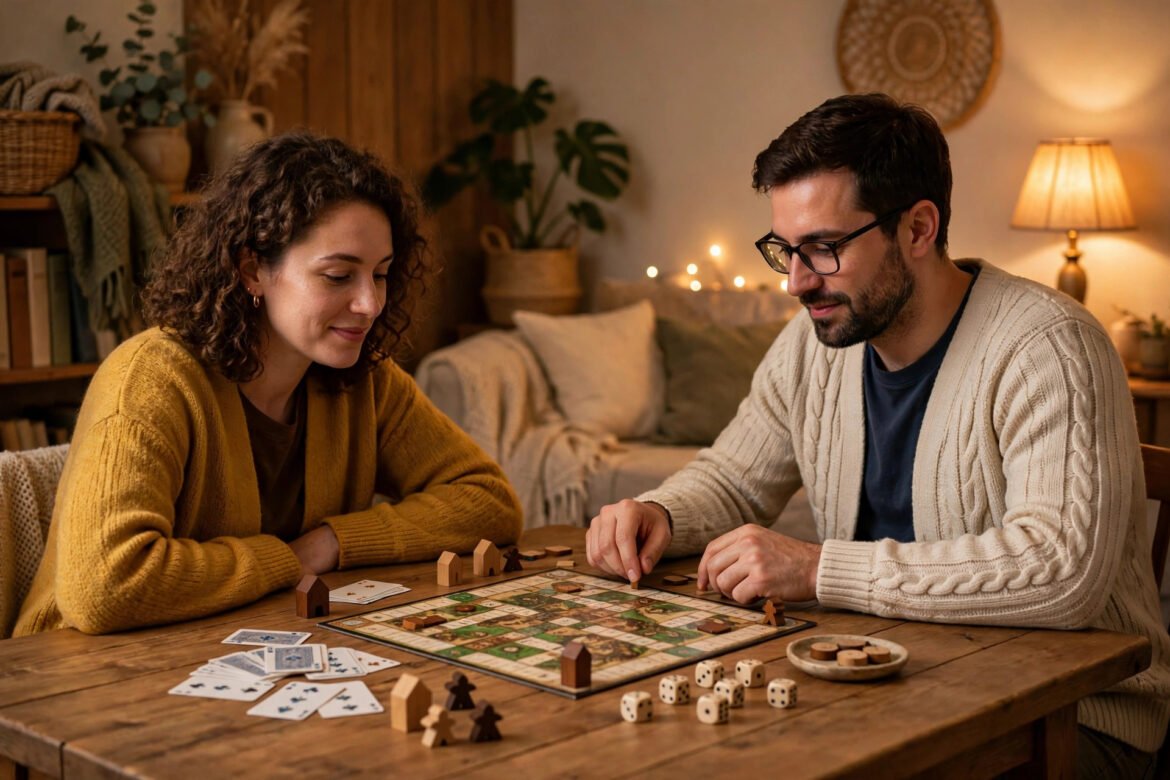
There is something special about a board game played with just two people. No waiting for a large group to agree on a night, no long turns spent watching other players take ages over a move, and no game that only really works when six people are round the table. A good 2 player board game is built for a pair: every decision matters, every move is aimed directly at one opponent, and a quiet evening can turn into a proper contest in the space of a single round. Whether you play with a partner, a friend, a sibling or a parent, two-player board games are one of the easiest and most rewarding ways to spend time together.
Yet the world of board games can feel overwhelming at first. Shelves are full of boxes promising strategy, adventure, mystery and mayhem, and many of them are designed for three or more players, with a two-player option squeezed in as an afterthought. The result is that some games feel flat with two, while others come alive. This guide explains what makes a great two-player board game, the main types worth trying, how to choose one you will both enjoy, and how to make a regular game night for two something you actually look forward to.
What Makes a Great 2 Player Board Game?
The best two-player games share a few qualities, whatever their theme. First, both players should feel involved from the first move to the last. In a weak two-player game, one player can run away with an early lead and the rest of the game becomes a slow formality. In a strong one, the score stays close enough that a clever late move can still change everything, and neither player feels like a spectator in their own game.
Second, the game should reward thinking without punishing it. Two-player games are at their best when you can see your opponent planning, try to second-guess them, and feel the tension of a move that could go either way. That does not mean every game needs to be a brain-burning strategy puzzle. A light, funny game with quick turns can be just as satisfying, provided both players have real choices to make rather than simply following the luck of a dice roll.
Third, the length matters more with two players than with a group. A game that takes an evening to finish can be wonderful on a free Saturday, but it is a poor choice for a weeknight after work. The best two-player collections include a mix: a couple of short games that take half an hour or less, and one or two longer games for weekends. That way, you always have something that fits the time you actually have, rather than a shelf of games you never get round to playing.

The Main Types of Two-Player Board Games
Two-player board games come in far more flavours than the classic abstract games most people grew up with. Knowing the main types helps you work out what you enjoy, and it stops you buying three games that are really the same game in different boxes.
Abstract strategy games are the purest form of two-player contest. There is usually no theme to hide behind, no luck to blame, and no hidden information: both players can see the whole board, and the better plan wins. Chess and draughts are the famous examples, but the modern hobby is full of smaller, elegant abstracts that take minutes to learn and a lifetime to master. These suit players who enjoy a direct battle of wits and do not mind losing to a better move rather than a bad dice roll.
Card-driven and deck-building games are a gentler entry point for many pairs. Players build up a hand or a deck over the course of the game, combining cards in clever ways to outscore or outmanoeuvre their opponent. These games often have a theme, from trading and exploring to building a small kingdom, and they tend to feel less confrontational than a bare board, because you are partly building your own engine while also watching what your opponent is building. They are a good choice when one player is new to board games.
Cooperative two-player games flip the usual contest on its head: instead of playing against each other, you play together against the game itself. You might be solving a mystery, escaping a place, surviving a scenario or completing a quest, and you win or lose as a team. Cooperative games are wonderful for pairs who would rather share a victory than beat each other, and they suit evenings when you want to work together rather than compete. Just be careful of one player taking over the decisions, which can leave the other feeling like a passenger.
Word, trivia and party-style games for two are a different pleasure altogether. They are usually quick, chatty and funny, and they work best when you know each other well, because the humour comes from shared knowledge and in-jokes. Some pairs love them; others find them frustrating if one player has a much larger vocabulary or a better memory for facts. Try one before you buy a shelf full of them, and look for games where both players answer or guess, rather than one player simply quizzing the other.
Finally, there are the big themed adventure and campaign games, where a story unfolds over several sessions and your choices carry forward from one game to the next. These can be deeply rewarding for a regular pair who play together often, because you build a shared story over weeks or months. They are a commitment, though, in time, table space and attention, so they suit a pair who already know they enjoy gaming together, rather than a first purchase.
How to Choose a Game You Will Both Enjoy
Choosing a two-player game is really about choosing for two people, not one. A game that one of you loves and the other merely tolerates will gather dust, however good its reviews. Start by talking honestly about what you both enjoy. Do you like direct competition, or do you prefer building something together? Do you enjoy a quiet, thoughtful game, or something lively and funny? Do you want a game you can play while chatting, or one that demands full concentration? There are no wrong answers, but the answers point to very different games.
Next, be realistic about time and complexity. A game that takes an hour to learn is a hard sell on a tired weeknight, however brilliant it may be once you know it. Look for a playing time and a learning curve that match your evenings, and remember that a short, simple game you play ten times is worth far more than a long, complex game you play once. If you are choosing between two games, the one you will actually get to the table is usually the better buy. The same thinking applies to matching a game to your mood and the time you have, which is why our guide to choosing a game to play for any mood, device or session is a useful companion: the question is not only what is good, but what is good for tonight.
Consider the theme, but do not let it decide everything. A beautiful theme can draw you in, and a theme you both love, whether that is history, nature, mystery or science fiction, makes learning a new game much easier. But a gorgeous box with a theme you love and mechanics you dislike will disappoint you faster than a plain-looking game with mechanics you enjoy. Read a short how-to-play summary or watch a brief playthrough before buying, and pay attention to what players actually do on a turn, rather than what the box promises.
It also helps to think about how competitive you both are, and how you handle losing. Some pairs thrive on ruthless, head-to-head games where every move is an attack. Others enjoy a gentler contest where you are mostly racing to build the best score, with only light interference in each other’s plans. Neither style is better, but mixing them up without discussion can lead to a sore evening. If one of you is much more experienced, a cooperative game or a game with a catch-up mechanism, where a player who is behind gets a small boost, can keep things friendly.

Setting Up a Two-Player Game Night
A game night for two does not need an occasion. In fact, the pairs who play most are usually the ones who make it a small, regular habit rather than a grand event. Pick a night that usually works, keep the session short enough that it never feels like a chore, and let either player suggest the game. A regular slot, even just one evening a week, turns board games from something you mean to do into something you actually do.
Keep the practical side simple. Choose a table with enough room for the board, cards and pieces without everything getting knocked over, and make sure the lighting is good enough to read small text comfortably. Put phones on silent if you can, not as a rule but as a favour to the game, because a two-player game loses its rhythm quickly when one player keeps checking messages. A drink and a snack nearby help, but keep food away from cards and boards, unless you enjoy the particular heartbreak of a spilled cup on a favourite game.
Learn the rules together, and be patient with the first play. Almost every game feels clumsy the first time, and the first game is really a learning game, not a fair contest. Agree before you start that you will allow take-backs and questions in the first play, and that the result does not quite count. That small agreement removes most of the pressure, and by the second play you will both be making real decisions and enjoying the game properly.
Board games also sit happily alongside digital play, and many pairs mix the two across a week. Some evenings call for a board and pieces on a table; others call for something on a screen. If you enjoy both, our guide to online games explains how to pick digital games that suit your connection and your mood, which is the same kind of matching that makes a board game night work. The point is not to choose one kind of play over the other, but to have both ready for different evenings.
Game-Night Tips for Two Players
A few small habits make two-player gaming much more enjoyable over time. First, rotate who chooses the game. If one person always picks, the collection slowly bends towards their taste, and the other player drifts away. Taking turns keeps the shelf balanced and means you both discover games you would never have chosen alone, which is often where the best finds come from.
Second, keep a short list of what you have played and what you thought. It does not need to be formal: a note on your phone with the game name, a quick score out of ten from each of you, and one line about what worked is enough. After a few months, that list becomes a surprisingly useful guide to your shared taste, and it stops you buying a game that is very like one you already own and rarely play.
Third, treat losing gracefully, and winning graciously. Two-player games are personal in a way group games are not: when you lose, you lost to one person, and that person is sitting right opposite you. A little good humour about a bad dice roll or a missed move goes a long way, and so does resisting the urge to explain, at length, exactly how your opponent could have played better. The best two-player rivals are the ones you want to play again, win or lose.
Fourth, do not be afraid to change a rule that is not working for your pair. House rules are a proud board gaming tradition, and a small tweak, such as shortening a game that drags, or removing a rule that always causes an argument, can rescue a game that would otherwise sit unplayed. Just agree the change together before the game starts, write it down, and use it consistently, so it feels like your version of the game rather than a mid-game negotiation.
Finally, remember that a game night is also a way to switch off after work. Many pairs play as a deliberate break from screens and work messages, a pocket of the evening that belongs to something enjoyable and unhurried. If you work from home, that boundary matters even more, and our guide to human resources for small businesses covers how small teams set up home working properly, including the practical side of keeping work hours and rest hours apart. A regular game night is a pleasant way to mark that line.

Playing on the Move and With a Small Collection
Two-player games travel well, which is one of their quiet advantages. Many of the best ones come in small boxes, need little table space, and can be played in a cafe, on a train table, or on holiday. If you travel together, a travel-friendly game or two in a bag can turn a wait or a quiet evening away into a highlight of the trip. Look for games with few loose pieces, a short setup, and rules you can remember without the rulebook, because those are the ones that actually get played away from home.
Staying connected while you travel can also matter, whether for looking up a rule, finding a local games cafe, or simply staying in touch. If you are weighing up a mobile plan for trips and everyday use, our guide to O2 SIM-only deals explains how to think about allowances and coverage, which is useful context when you are deciding what you need on the move. It is a small detail, but a game night away from home runs more smoothly when the practical side is already sorted.
You do not need a large collection to enjoy two-player board games. In fact, a small collection played often is usually more satisfying than a large one played rarely. A good starting shelf might include one quick card game, one thoughtful strategy game, and one cooperative game, which together cover most moods and evenings. Add to it slowly, one game at a time, and only when you have played your current games enough to know what is missing.
Common Mistakes to Avoid
- Buying a group game with a weak two-player mode: A game designed for four or more players often feels empty with two, even if the box says it supports two.
- Choosing only for yourself: A game one player loves and the other tolerates will gather dust, however good its reviews.
- Starting with the longest, heaviest game: A long, complex first game can put a new player off the hobby entirely.
- Skipping the learning game: Treating the first play as a serious contest, before either player knows the rules, leads to frustration.
- Judging a game by its theme alone: A beautiful theme cannot rescue mechanics you do not enjoy.
- Letting one player dominate a cooperative game: If one person makes every decision, the other is not really playing.
- Buying too many games at once: A shelf of unplayed games is less fun than a small collection you know well.
Frequently Asked Questions
What is the best type of board game for two players? It depends on what you both enjoy. Abstract strategy suits a direct battle of wits, card-driven games suit players who like building combinations, and cooperative games suit pairs who would rather win together than beat each other. Trying one of each is the quickest way to find your shared taste.
How long should a two-player board game take? For a weeknight, look for games that take around half an hour, so the game fits comfortably into an evening without feeling rushed. Longer games are better saved for weekends or free evenings, when you can enjoy them without watching the clock.
Are cooperative games good for two players? Yes, they can be excellent for a pair, because you share every decision and every result. The main thing to watch is that both players genuinely contribute, rather than one player directing the other, which can spoil the experience.
What if one player is much more experienced than the other? Choose a cooperative game, a game with a catch-up mechanism, or a new game that neither of you has played before, so you learn together. A learning game where take-backs are allowed also helps level the field for the first few plays.
Do I need a big collection to enjoy two-player games? No. A small collection of three or four games that suit different moods, played often, is more satisfying than a large shelf of games you rarely touch. Add new games slowly, once you know what your current collection is missing.
Can two-player board games be played while travelling? Yes, many of the best two-player games come in small boxes, need little table space, and can be played in a cafe or on holiday. Look for games with few loose pieces and rules you can remember without the rulebook.
Final Thoughts
A great two-player board game is not about the biggest box or the most elaborate theme. It is about two people, a shared contest or a shared challenge, and an evening that feels well spent. Start with what you both enjoy, keep the collection small, learn the rules together without pressure, and let the game night become a regular habit rather than a rare event. Do that, and a simple board on a table can become one of the best parts of your week.